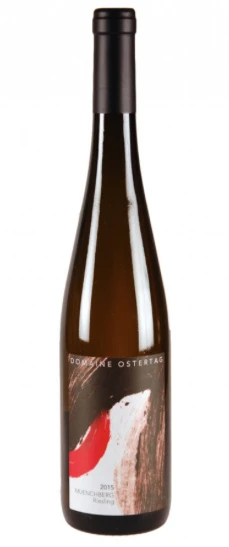
2015 Domaine Ostertag Muenchberg
Original price was: £44.55.£31.19Current price is: £31.19.
- Worry-Free Shopping with Safe Payments
- Quality products for every lifestyle.
- High quality products, hassle-free returns.
- Quality products, fair prices.

Revue du Vin de France 3 *** (Field of excellence); Bettane & Desseauve 4BD (production of very high quality);
Gault Millau: 6 * Exceptional
Do you like Rodin, Michelangelo? You will love André Ostertag, the sculptor of the terroirs of Alsace. This pure Alsacian juice is not only an artist but a revolutionary. When he returned to Alsace after being trained in Beaune, he incorporated new barrels into his herds, notably on his famous cuvées de pinot gris, a grape variety originating in Burgundy. Breaking with local tradition, he shocked his colleagues but the result is exceptional. Wines of fruit, stone wines or time wines, the whole panoply of wines that it shapes is vibrant with emotions and depth.
It was in 1980 that André Ostertag took the reins of the family estate, created in 1966 by his father. At the age of 21, he returned to his native land, and gradually laid his imprint on the conduct of the estate. The yields are lowered, tests on the farms are undertaken by integrating the new one on the breeding of certain grape varieties. Electron free in the Alsatian landscape, André Ostertag shakes the required meadows and established order. His monumental vintage “A360P” Pinot Gris Grand Cru Muenchberg is denied the approval of the appellation. He is a spirit of a free spirit and deeply passionate about vines, soils and the soil, he traces his path and continues to develop his craft towards a cultural and artistic dimension. The domain now counts 14.4 ha scattered over 5 villages in the Bas Rhin: Epfig (63%), Nothalten (30%), Itterswiller (2%), Ribeauvillé (4%) and Albé (1%). The estate is spread over “more than 80 small vineyards linked together by the same spirit”, as the domain likes to emphasize.
At the vineyard, the domain is conducted in a respectful way of the plant, the life of the soil and the fauna. The whole field has been carried out in biodynamics since 1998. Various animal or vegetable preparations such as the 500 (cow dung buried in a cow horn) or 501 (silica-based preparation) are therefore used to promote microbial activity , deep root growth or photosynthesis. In order to increase their natural defenses, the vines are treated with herbal teas (nettle, fern, horsetail, comfrey). Soils regularly maintained on two thirds of the plot: plowing, butting, scraping, trimming, mowing. No weed killer, chemical fertilizer or insecticide is used. Green work such as trimming, deburring, trellising, trimming and trimming is entirely manual. André Ostertag shares his experiences and observations with his friend Dominique Lafon in Meursault, and shares his belief that biodynamics brings a “finer, broader and ultimately more human approach to this formidable profession of winegrower”. According to André Ostertag, “biodynamics favors an artistic approach based on man at the expense of an industrial approach based solely on the concept of economic profitability. It develops intuition and sensitivity, qualities indispensable to great wine “. The grapes are harvested at maturity, by hand, after a first sorting in the vineyard.
In the cellar, vinification is natural, respectful of grapes and carried out in a non-interventionist approach. The pneumatic pressings are long and carried out smoothly for 8 to 12 hours. The dregs, the nurturing mother of the wine, are preserved as long as possible. Each gesture is measured here, groomed and applied in a gentle and delicate way so as not to rush the wine. The choice of breeding is reflected and adapted to the vintage, the terroir but especially the grape variety. The barrel is used for grape varieties of the oxidative type (Pinot Blanc, Gray and Noir) and the vat for reducing grape varieties. The wines are then bottled in delicacy. André Ostertag distinguishes three types of wines: fruit wines (expression of the grape variety), stone wines (expression of the terroir) and time wines (expression of overmature and patience).
The soil and the soil: The Grand Cru Muenchberg is located at the foot of the Vosges, sheltered by the mountain of the Ungersberg, which protects it from bad weather. The soil consists of an assemblage of pink sandstone of the Vosges and volcanic sediments, a unique marriage in Alsace. Its ideal altitude (between 250 and 300 meters) protects it from excessive heat, while preserving great complexity in the wines. André Ostertag describes with poetry the universe of this cuvée: “Fascination of the sandstone with the fuzzy undulations with the living skin and warm animal belly that drinks the light with full laps”.
| Article number | 017dn81026 |
|---|---|
| EAN Code | FALSE |
| Alcohol % | 14 |
| Volume in ml | 750 |
| Weight in gr | 1300 |
Be the first to review “2015 Domaine Ostertag Muenchberg”
Related products
Reviews
There are no reviews yet.